
Did you know that when the thermometer drops to -17°C, your car battery loses approximately 60% of its starting power? It’s a frustrating reality for drivers across Airdrie and the surrounding Rocky View area. You’re likely already running late, and the hollow click of a dead engine is the last thing you need. Finding professional battery boosts becomes an urgent priority when you’re stuck without jumper cables or a second vehicle. It’s natural to worry about the sensitive computers in your car, especially since a single mistake during a jump start can lead to thousands of dollars in electronic damage.
We understand that you need a solution that’s both safe and dependable. This guide explains why Alberta’s climate causes such frequent failures and how you can protect your vehicle’s longevity. You’ll also learn about the latest 2026 provincial towing regulations and Move Over laws designed to keep everyone safe on the shoulder. We provide a clear look at how to get your vehicle started reliably so you can reach your destination with total peace of mind.
Key Takeaways
- Understand how Airdrie’s rapid Chinook temperature shifts create more chemical stress on your battery than consistent freezing temperatures.
- Learn the critical safety checks to perform before attempting battery boosts to prevent damage from hidden leaks or casing cracks.
- Identify the specific risks that voltage spikes pose to modern Engine Control Units and how to protect your vehicle’s digital systems.
- Stay informed on the 2026 Alberta Traffic Safety Act updates regarding roadside assistance and “move over” requirements for your security.
- Discover why professional-grade equipment offers a more dependable solution for vehicles in Airdrie, Crossfield, and the surrounding Rocky View area.
Why Car Batteries Fail: The Airdrie and Rocky View Context
The chemical reactions inside a standard lead-acid battery are highly sensitive to the temperature outside. When the mercury drops, the internal resistance within the battery increases, which slows down the flow of electricity. This makes it significantly harder for the unit to release the energy needed to turn your engine over. While many drivers believe steady cold is the primary enemy, Airdrie’s famous Chinooks are often more damaging to long-term health. These rapid temperature shifts cause the battery casing and internal components to expand and contract. This physical stress can lead to micro-cracks or internal plate degradation over time. Understanding how to properly jump-start a vehicle is helpful, but preventing the failure in the first place is always the better route.
To better understand the mechanics of getting your car moving again, watch this helpful video:
Watch for early warning signs before you find yourself stranded in a parking lot. A slow engine crank, dimming headlights at idle, or a clicking sound when you turn the key are clear indicators that your power levels are low. Modern vehicles in the Rocky View area also face “parasitic drain.” Advanced security systems, GPS trackers, and remote starters constantly pull small amounts of current even when the car is off. If your vehicle sits for a few days during a cold snap, these systems can deplete a weakened battery entirely. Professional battery boosts are frequently the only way to overcome this deep discharge safely.
The Impact of Alberta Winters on Battery Life
At temperatures of -17°C, a battery’s cranking power drops by approximately 60%. This happens exactly when your engine oil has thickened, requiring more force to start the car. It’s a perfect storm for failure. If you notice your battery case is bulging or looks frost-covered, do not attempt battery boosts. A frozen battery can explode if it receives a sudden surge of current. Using a block heater for at least four hours before driving reduces the initial cranking load, making it much easier for your vehicle to fire up on those bitter mornings.
Short Trips vs. Long Commutes to Calgary
Your driving habits play a massive role in battery longevity. Frequent short trips to local spots like CrossIron Mills or Airdrie shopping centres don’t allow your alternator enough time to replace the energy used during the start-up process. In contrast, the daily commute down Highway 2 to Calgary provides a steady 20 to 30 minutes of charging. This longer run is essential for maintaining a full state of charge. If you mostly drive short distances, your battery stays in a permanent state of undercharge, which significantly shortens its typical three-to-five-year lifespan.
The Safety-First Guide to Performing Battery Boosts
Performing battery boosts is a high voltage procedure that requires absolute attention to detail. Before you even reach for a set of jumper cables, prioritize your personal safety. Acid-resistant gloves and impact-rated eye protection are essential pieces of equipment, not optional suggestions. Lead-acid batteries contain sulphuric acid and can emit highly flammable hydrogen gas during the charging process. A single spark near the battery terminal can ignite this gas, leading to a catastrophic explosion. If the situation feels unsafe or you lack the proper gear, contacting a professional for a car jumped taxi service is a much more secure alternative.
Begin by inspecting the dead battery for any signs of physical failure. Look for leaks, cracks in the plastic casing, or visible bulging. As mentioned previously, if the battery is frozen, attempting a boost is extremely dangerous. You must also ensure that the two vehicles are not touching each other. If the metal bumpers or bodies make contact, it can create an unintended ground circuit. This can lead to a massive electrical surge that causes permanent damage to your vehicle’s electronics and sensitive sensors.
Step-by-Step Connection Sequence
Follow this specific order to minimize the risk of short circuits and sparks:
- Step 1: Attach the red (positive) clamp to the positive terminal of the dead battery.
- Step 2: Connect the other end of the red cable to the positive terminal of the donor vehicle’s battery.
- Step 3: Connect the black (negative) clamp to the negative terminal of the donor vehicle’s battery.
- Step 4: Attach the final black clamp to a clean, unpainted metal surface on the engine block of the stalled car, away from the battery itself.
Common Jump-Starting Mistakes to Avoid
The most dangerous mistake is reversing the polarity. Crossing the cables by connecting positive to negative can instantly fry your alternator and melt the wiring harness. This error often results in repair bills that far exceed the cost of a new battery. Another frequent oversight is removing the cables too quickly. Once the vehicle starts, the alternator needs a few minutes to stabilize the voltage. If you disconnect the cables immediately, the sudden load change can cause a voltage spike. Finally, never lean directly over either battery while the engine is being cranked. If a casing failure occurs, your face and eyes should be as far away as possible from the potential blast zone.
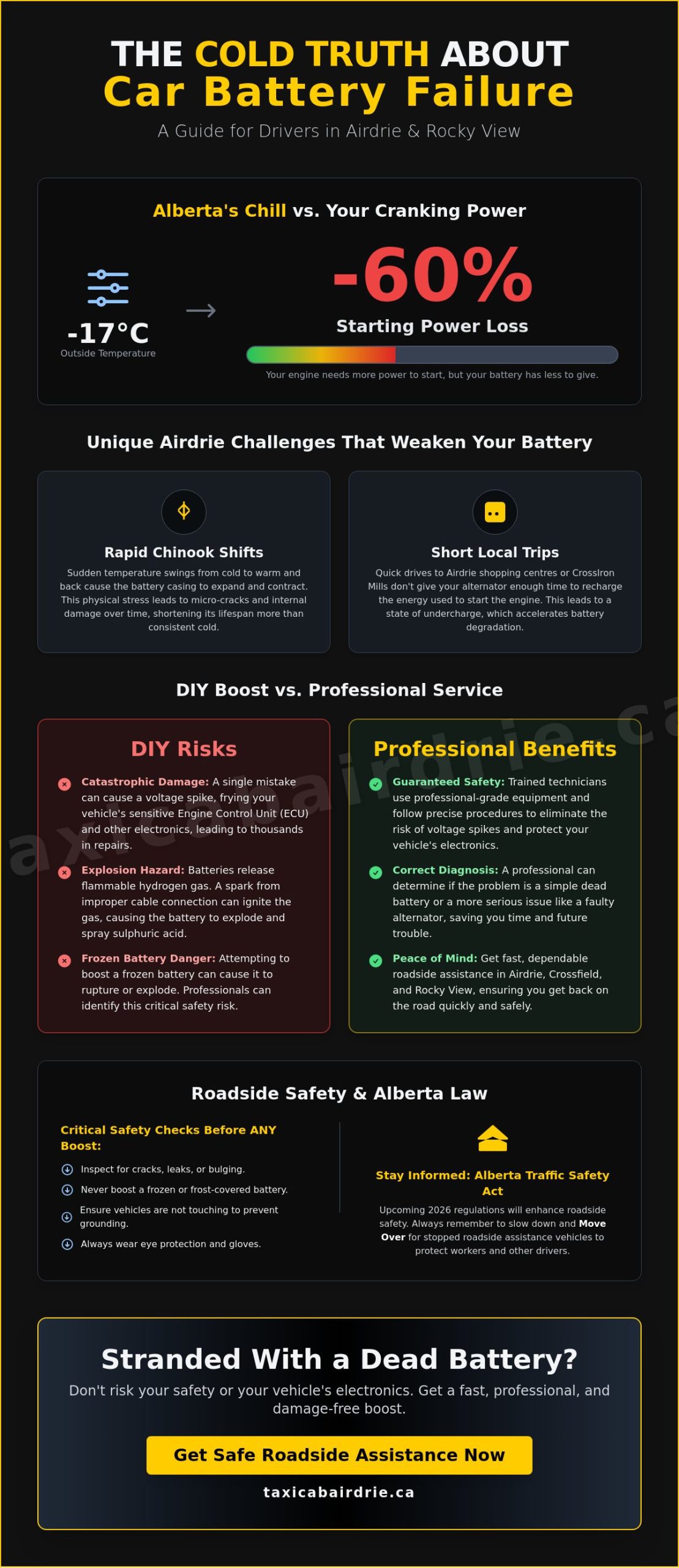
DIY vs. Professional Battery Boost Services
Portable lithium-ion jump starters have become popular additions to many emergency kits, but they often fail when you need them most. In a deep Alberta freeze, these compact consumer packs can lose their internal charge rapidly. They simply lack the “cold cranking amps” required to turn over a frozen engine block. A professional service uses high-capacity lead-acid boosters or heavy-duty vehicle alternators that provide consistent power regardless of the temperature. Choosing professional battery boosts ensures that the equipment is capable of overcoming the high internal resistance found in vehicles that have sat through a -30°C night.
Physical safety is another major factor that favours professional help. Handling jumper cables involves more than just matching colours. You risk electrical shock or painful acid burns if a battery casing has failed internally. Professional technicians are trained to spot these hazards immediately. They offer a level of accountability that a stranger in a parking lot cannot provide. Whether you are stranded at CrossIron Mills or picking up kids from an Airdrie school, a professional responder arrives with the right tools and the right training to get the job done without incident.
When to Call for Professional Roadside Help
Some situations are too complex for a standard DIY attempt. Many modern luxury vehicles house their batteries in the trunk or behind a wheel well, making access difficult for short consumer cables. If you smell a “rotten egg” scent, this indicates leaking sulphuric acid. Do not attempt to touch the battery in this state. Also, if you hear a rapid clicking sound but the engine won’t turn, your battery might be too depleted for a consumer-grade booster. In these cases, a local taxi service can provide the high-amperage jump needed to get you moving.
Comparison: Taxi Boosts vs. Traditional Towing
Speed is the deciding factor when you are stuck in the cold. A local cab is usually positioned within the city limits and can often arrive three times faster than a heavy-duty tow truck. During peak winter periods, towing companies often prioritize accidents or vehicle recoveries, leaving simple boost calls at the bottom of a long list. During a 2019 cold snap, rural Alberta saw call volumes spike 8.5 times higher than normal, which can lead to hours of waiting for a tow truck. Instead of waiting on hold with a national dispatch centre, using a car jumped taxi service in Airdrie puts a professional driver at your door in a fraction of the time.
Cost efficiency is another clear benefit. Most towing companies charge a heavy-duty minimum fee just to show up. In contrast, many local providers offer flat-rate battery boosts that are much more budget-friendly. This reliability extends to smaller communities like Beiseker or Irricana, where a Rocky View taxi service remains a vigilant and honest partner for residents. You get the same professional result without the long wait or the high price tag of a flatbed truck.
Protecting Your Vehicle’s Sensitive Electronics
Modern vehicles are essentially sophisticated computers on wheels. While older cars were largely mechanical, today’s models rely on an intricate network of Engine Control Units (ECUs) to manage everything from fuel injection to safety sensors. These components are extremely sensitive to voltage fluctuations. During battery boosts, a sudden surge of electricity can overwhelm these circuits, potentially “frying” the vehicle’s brain. This isn’t just a minor inconvenience; a damaged ECU can lead to permanent vehicle failure. Protecting these digital systems requires more than just a pair of cables; it requires a professional understanding of electrical load management.
Digital dashboards and infotainment centres are equally vulnerable. A voltage spike can cause pixels to burn out or software to corrupt, leading to expensive repairs for your interior displays. Many newer European vehicles have even stricter requirements. These cars often need a specific “relearning” or registration process after a battery dies to ensure the alternator charges the boosted unit correctly. Professional roadside responders often use specialized surge protectors during the process. These devices act as a buffer, absorbing any dangerous electrical noise before it reaches your car’s sensitive hardware.
Voltage Spikes and Modern Alternators
One of the most dangerous moments occurs during the “load dump” phenomenon. This happens when the jumper cables are disconnected while both engines are running. The sudden change in the electrical path can cause the alternator to produce a massive voltage spike. You can mitigate this risk by turning on your heater or rear defroster before removing the cables. These heavy electrical loads help absorb the excess energy. Additionally, using an older donor vehicle with a failing voltage regulator is risky. A professional Airdrie taxi provides a stable, regulated power source that eliminates these unpredictable variables.
The ‘Smart’ Battery Management System (BMS)
Newer cars utilize a Smart Battery Management System (BMS) to monitor health and charging rates. When a battery fails, the BMS may trigger a series of false error codes that stay on your dashboard even after the car starts. Some vehicles won’t even accept a boost if you connect directly to the battery terminals. They require you to use specific “boost points” located elsewhere under the hood. A professional driver understands these regional vehicle variations and ensures the connection is made exactly where the manufacturer intended. If you want to avoid a trip to the dealership for computer resets, call Airdrie Cab for a safe, expert boost today.
Fast Roadside Assistance and Battery Boosts in Airdrie
Yellow Cabs Airdrie Taxi serves as a dependable roadside partner for the entire community. We are more than just a transportation service; we are a utility that stays available when other providers have finished their shifts. Our professional drivers are stationed throughout Airdrie, Crossfield, Beiseker, and Rocky View to ensure help is always nearby. We understand that a dead battery creates immediate anxiety, especially during a cold snap. Our team is trained to perform battery boosts with precision, ensuring your vehicle’s sensitive electronics remain protected throughout the process. You can rely on Yellow Cabs Airdrie Taxi to provide honest, punctual assistance whenever you find yourself stranded.
Our Extended Roadside Support Services
Sometimes a dead battery is only one part of the problem. If you find yourself running on empty, our emergency gas delivery service in Airdrie can bring fuel directly to your location to get you to the pump. If your car requires more extensive repairs at a shop, our Airdrie cab is ready to take you home or to your next appointment. We also offer a unique solution for those who are unable to operate their own car due to fatigue or illness. Our ‘we drive you and your vehicle’ service ensures that both you and your car arrive home safely without any additional stress. And if you need something delivered across town while your car is being serviced, our on-demand parcel delivery in Airdrie keeps your errands moving even when you can’t.
How to Request an Immediate Boost
Getting help is straightforward and fast. You can use our online booking system or send a quick text message to reach our dispatch team. This streamlined process allows us to send the nearest driver to your exact coordinates without delay. Yellow Cabs Airdrie Taxi prides itself on transparent pricing for all battery boosts. You won’t face hidden fees or surprise emergency surcharges just because it’s a holiday or a cold Sunday morning. We believe in providing value and clarity to every resident in the Rocky View region. Our goal is to get you back on the road with total peace of mind. Parents who rely on us for professional school runs in Airdrie know that the same dependable drivers and transparent service extend to every roadside emergency we handle.
Call or Text Yellow Cabs Airdrie Taxi for a fast battery boost now!
Get Back on the Road with Confidence
Alberta’s unique prairie climate demands a specialized approach to vehicle maintenance. As we have discussed, the combination of rapid Chinook temperature shifts and sensitive modern electronics makes professional care a necessity rather than a luxury. By understanding the risks of voltage spikes and the limitations of consumer-grade equipment, you can make informed decisions that protect your vehicle’s long-term health. You no longer have to worry about the complexities of Engine Control Units or the dangers of improper cable connections when a local expert is just a message away.
Yellow Cabs Airdrie Taxi provides the dependable utility you need with 24/7 emergency dispatch across Airdrie, Crossfield, and the entire Rocky View region. Our professional and courteous drivers are trained to deliver safe battery boosts that prioritize your peace of mind and your vehicle’s security. We pride ourselves on being a hardworking, honest partner for our community, offering fast response times without hidden surcharges. Request a Fast Battery Boost in Airdrie Now and let our team get you moving safely again. We are always here to ensure your journey continues without delay.
Frequently Asked Questions
How much does a professional battery boost cost in Airdrie?
Rates for roadside assistance vary depending on the provider and your specific location within the Rocky View region. Most local companies offer a flat-rate fee for a standard boost, which is often more budget-friendly than the minimum charges required for a tow truck. You should confirm the current rate with the dispatcher when you request assistance to ensure clarity before the driver arrives.
Can a dead battery be boosted in -30 degree weather?
Yes, you can boost a battery in extreme cold as long as the unit is not physically frozen. At -30°C, your engine oil thickens and the battery’s output drops significantly, which often requires the high-amperage power that only professional equipment can provide. Always inspect the casing for bulging or frost before attempting battery boosts, as a frozen battery can be dangerous to jump-start.
Will jump-starting my car damage the computer or electronics?
There is a risk of damaging sensitive electronics if the procedure is performed incorrectly. Modern vehicles rely on Engine Control Units that are highly sensitive to the voltage spikes that can occur when cables are connected or removed. Professional responders use specific safety sequences and stable power sources to mitigate these risks and protect your vehicle’s digital infrastructure.
How long should I drive my car after getting a battery boost?
You should drive your vehicle for at least 30 minutes to allow the alternator to replenish the battery’s charge. Ideally, this should be a continuous drive at highway speeds, such as a trip down Highway 2, rather than short stop-and-go trips to local shopping centres. If the battery is more than three years old, it may struggle to hold this new charge and should be tested by a professional.
Do I need to have my own jumper cables for a taxi boost?
No, you do not need to provide any equipment when you call for professional help. Our drivers carry heavy-duty cables and professional-grade booster packs that are designed to handle the high electrical resistance found in frozen Alberta engines. This service is especially helpful for drivers who don’t have the space to store their own emergency gear.
What should I do if my car won’t start even after a boost?
If the vehicle fails to turn over after a professional boost attempt, the problem likely extends beyond a simple discharged battery. The issue could be a faulty starter motor, a failed alternator, or a battery that has reached the end of its life and can no longer hold current. In these situations, you will need to arrange for a tow to a local mechanic for a proper diagnosis.
Can I get a battery boost at the Calgary Airport (YYC) from an Airdrie service?
Yes, local services frequently assist travellers who return to dead batteries in the Calgary International Airport parking lots. Because we provide regular airport shuttle services, our drivers are often in the immediate vicinity and can reach YYC quickly. This is a reliable and fast solution for Airdrie residents who find themselves stranded after a long flight.
Is it safe to boost a hybrid or electric vehicle (EV)?
It is generally safe to boost the 12-volt auxiliary battery in a hybrid or EV, but you must use the manufacturer’s designated jump-start points. These are often located in the fuse box under the hood rather than on the battery itself. Never attempt battery boosts on the high-voltage traction battery used to power the electric motors, as those systems require specialized dealer service.

4 Responses